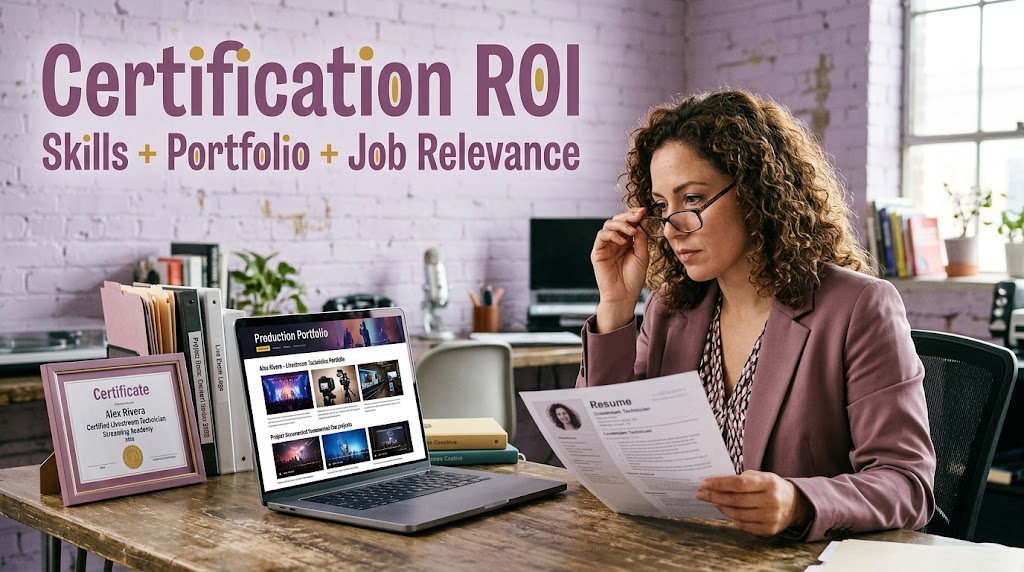
A creative industry that worships portfolios can still glance at the certificate hanging beside them. That tension is exactly where livestream certification becomes interesting because a credential can signal structured training, but it cannot automatically prove that someone can keep a live production running when the audio suddenly disappears.
The real question, then, isn’t whether a certificate looks professional, but whether it creates enough measurable value to justify the time and money.
The answer depends heavily on the role, the certification provider, and what you can actually demonstrate afterward.
1. Livestream Certification Has Value When The Credential Matches A Real Production Skill
A certificate is strongest when it validates something an employer already needs. It becomes much weaker when it’s simply a badge claiming that you’ve completed a course.
vMix Certified Training Can Be More Relevant For Certain Production Roles
Software-specific credentials make the most sense when the tool is genuinely used in the workplace. vMix offers official training and certification pathways around its production software, making this type of credential more relevant to operators working with live switching, graphics, recording, streaming, and production workflows.
For someone targeting technical production, proving streaming proficiency with a recognized workflow can be useful. But certification shouldn’t replace a portfolio showing that you can actually build scenes, configure inputs, manage audio, troubleshoot sources, and produce a clean live output.
That’s the important distinction.
A recruiter may understand what a recognized certification means in seconds. They still need evidence that you can perform under pressure.
OBS Skills Are Useful Even Without A Traditional Certification
OBS Studio is widely used for livestreaming, but the value here isn’t necessarily a formal certificate. The stronger signal can be demonstrable ability with scenes, sources, audio, encoding settings, transitions, recording, and troubleshooting.
This matters because broadcasting credentials aren’t equally valuable. A credential attached to software that employers actually use is easier to connect to a job than a generic “livestream expert” certificate with unclear assessment standards.
The Employer Still Cares About Experience
The U.S. Bureau of Labor Statistics provides a useful reality check. Producers and directors had a median annual wage of $90,360 in May 2025, but the occupation typically requires several years of related production experience in addition to formal education.
So a certificate can support your story, but it rarely becomes the whole story.
For media employment, employers may care about:
- What equipment have you operated?
- Can you troubleshoot a live failure?
- Have you worked with real guests or clients?
- Can you follow a production rundown?
- Can you produce consistently under deadline?
- Can you show previous work?
A certificate answers only part of that list.
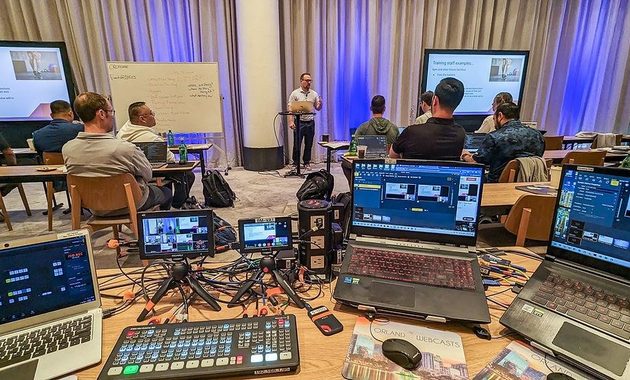
2. Calculate The ROI Before Paying For Broadcasting Credentials
The simplest way to judge a certification is to stop looking at the badge and calculate the return.
Suppose a course costs $300 and takes 30 hours. That’s already $10 of direct course cost per learning hour before accounting for your time. If the certification doesn’t improve your skills, portfolio, interview performance, or access to relevant jobs, the financial return is difficult to justify.
A Good Certification Should Improve More Than Your Resume
Look for training that leaves you with something tangible.
A useful certification program should ideally help you produce:
- A complete live production workflow.
- A documented technical project.
- Evidence of troubleshooting ability.
- Practical assessments rather than passive video watching.
- Skills that match actual job descriptions.
That’s where streaming proficiency becomes measurable instead of just being a phrase on LinkedIn.
If you’re comparing different learning routes, this guide to livestreaming certifications and digital media skills can help you understand where certification fits into a broader skills strategy.
Check Whether The Certification Is Actually Recognized
Not every credential carries the same weight.
Before paying, check:
- Who issues the certificate?
- Is the organization established?
- Is there a practical examination?
- Does the curriculum identify specific production skills?
- Do relevant job postings mention the certification?
- Can previous students demonstrate real work?
- Does the credential expire or require renewal?
If the answer to most of these questions is no, be cautious.
A shiny digital badge can look impressive for five minutes. A real production portfolio can keep working for you for years.
Compare Certification Against A Portfolio Project
Imagine two applicants.
Applicant A has three certificates but has never operated a live production.
Applicant B has one relevant certification and a portfolio showing three complete broadcasts, including one technical failure and how it was fixed.
For many practical production roles, Applicant B has the stronger evidence.
That doesn’t make certificates useless. It means credentials work best as supporting evidence, not as a substitute for competence.

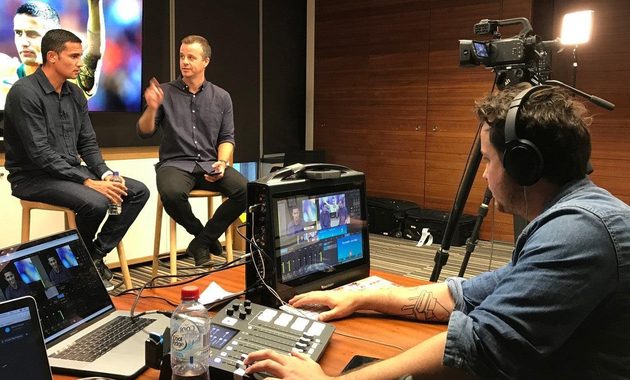
3. The Best Livestream Certification Strategy Is Skill First Credential Second
The smartest approach is to choose the role before choosing the certificate.
If you want to become a live video operator, prioritize switching, encoding, audio, signal flow, and troubleshooting. If you want production management, focus more heavily on planning, communication, crew coordination, budgets, and live show execution.
This approach also prevents a common mistake: collecting certificates without developing a professional identity.
The BLS data supports the broader point. Producers and directors work across film, video, streaming distribution, social networks, sports, performing arts, and broadcasting, with streaming distribution services, social networks, and other media networks accounting for 13% of employment in the occupation in 2025.
That means the industry is broader than one specific livestream platform.
When Paying For Certification Makes Sense
A credential is worth considering when:
- You’re changing careers and need structured learning.
- You lack formal production experience.
- The certification teaches software used by your target employers.
- It includes practical assessment.
- You can afford it without financial pressure.
- You will immediately use the skills in real projects.
When You Should Probably Skip It
Be skeptical when the provider promises guaranteed employment, extraordinary salaries, or professional status simply because you completed a short course.
That’s where marketing can get louder than the actual training.
A better investment may be spending the same money on equipment, supervised production experience, a portfolio project, or specialized technical training.
In other words, don’t buy a certificate because it looks good. Buy training because it makes you better.

Natsumi Kurose is a former digital learning coordinator who spent more than eight years helping universities, language schools, and professional training providers deliver live online classes.
She has worked with instructors on camera preparation, audience interaction, webinar structure, and technical rehearsal. Her writing focuses on livestreaming education, practical skills, online certifications, and learning programs for aspiring hosts and digital media professionals.