
Livestreaming certifications can help beginners show that their digital media skills are not only based on casual practice. A certificate does not automatically make someone an expert, but it can give structure, proof, and direction for people who want to be taken more seriously in livestreaming-related work.
Many beginners learn livestreaming from trial and error. They test a camera, fix bad audio, watch tutorials, try a live session, and slowly improve. That process is useful, but it can be difficult to explain to others. A certification can become a simple way to show that the learner has completed training, understood certain topics, and practiced specific skills.
For students, beginner creators, online sellers, event assistants, and career switchers, certifications can act like a small badge on a growing digital portfolio. It is not the whole story, but it helps people see the direction of your learning.
Why Livestreaming Certifications Matter For Beginners
Before choosing any certificate, beginners should understand what certifications can and cannot do. A livestreaming certificate is useful when it supports real learning, practical skill, and clearer professional positioning.
A Certificate Is Proof Of Learning, Not Instant Expertise
A certificate should not be treated like a magic key. It does not replace practice, experience, or a strong portfolio. However, it can prove that someone has studied a topic seriously.
For example, a beginner who completes training in livestream setup, hosting basics, audio preparation, and audience interaction can show that they have learned more than random tips from scattered videos.
That proof can be helpful when applying for small digital media roles, joining freelance projects, or building trust as a beginner creator.
Certifications Can Organize A Messy Learning Path
Livestreaming has many parts. Beginners may feel pulled in different directions: camera, microphone, lighting, scripts, software, audience engagement, safety, and platform rules.
A good certification program usually arranges those topics into a clearer order. Instead of learning everything like spilled puzzle pieces, beginners can follow a path that builds from basic knowledge to practical application.
7 Positive Ways Livestreaming Certifications Build Credibility
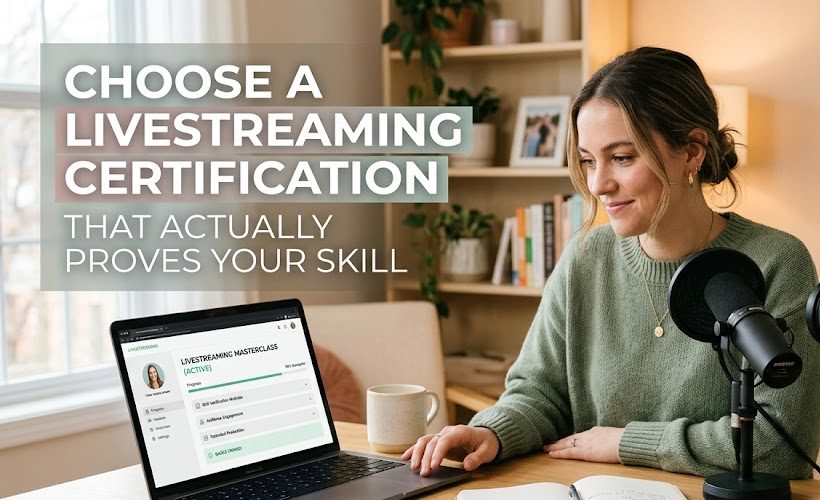
Certifications become valuable when they help beginners show real understanding. The best ones do not only give a downloadable badge, but also teach skills that can be used in actual live sessions.
1. They Show You Have Learned The Fundamentals
A livestreaming certification can show that you understand the basic foundation of live digital media.
This may include:
- how livestreaming works
- basic equipment needs
- audio and camera preparation
- session planning
- audience interaction
- platform awareness
- simple troubleshooting
- privacy and safety basics
For beginners, this matters because fundamentals are often ignored. Many people want to look professional too quickly, but forget simple things like clear audio, stable connection, and a planned opening.
A certificate that covers fundamentals helps show that you have started from the right floor, not from the roof.
2. They Make Your Skill Easier To Explain
Saying “I know livestreaming” can sound too broad. What does it mean? Hosting? Technical setup? Content planning? Live selling? Webinar support?
A certification can help make your skill easier to explain. If the program has clear modules, you can mention what you learned in a portfolio, resume, profile, or project pitch.
| Certification Area | What It Can Show |
|---|---|
| Hosting basics | You can guide a live session clearly |
| Technical setup | You understand camera, audio, and connection checks |
| Content planning | You can prepare topics and session flow |
| Audience interaction | You know how to handle comments and questions |
| Safety awareness | You understand privacy and risky online behavior |
This makes your skill less vague. People can see what part of livestreaming you have studied.
3. They Can Support A Beginner Portfolio
A portfolio is important in digital media, but beginners do not always have many projects yet. A certification can help fill that early gap.
It can be added to:
- personal website
- LinkedIn profile
- creator media kit
- freelance profile
- resume
- online portfolio
- proposal document
Of course, a certificate should not stand alone. It becomes stronger when combined with small examples, such as practice recordings, event support experience, sample scripts, or a checklist you created.
Think of certification as the label on a folder. The real value is still inside the folder, but the label helps people understand what they are looking at.
4. They Help You Learn With Clear Standards
One useful thing about certifications is that they usually have learning standards. This means learners are expected to understand certain topics before receiving proof of completion.
These standards may include quizzes, projects, assignments, or final reviews. That can push beginners to study more carefully.
Without standards, it is easy to feel productive while only watching videos passively. A certification program may ask learners to complete tasks, answer questions, or submit practice work.
That small pressure can be healthy. It encourages beginners to move from “I watched the lesson” to “I can apply the lesson.”
5. They Can Increase Confidence In Professional Settings
Confidence is not only about personality. Sometimes confidence comes from preparation.
If you have completed a livestreaming certification, you may feel more ready to help in situations such as:
- supporting a webinar
- preparing a simple live event
- assisting an online seller
- hosting a beginner session
- checking audio before a broadcast
- explaining live setup to a small team
This does not mean you will never feel nervous. Live content can still surprise anyone. But certification can reduce the feeling of being completely unprepared.
It is like carrying a small map before entering a new city. You may still take a wrong turn, but you are not walking blind.
6. They Help Employers Or Clients Understand Your Focus
For beginners, one problem is being too general. If your profile only says “digital media,” people may not know what you can actually do.
A livestreaming certificate can show a more specific focus. It tells employers, clients, or collaborators that you are interested in live content, online broadcasting, digital events, or creator production.
This can be useful for roles related to:
- webinar assistance
- social media live support
- online event coordination
- creator support
- live shopping assistance
- digital training support
- content production
Even if the certificate does not guarantee a job, it can make your direction easier to understand.
7. They Encourage Continued Learning
A good certification should not feel like the final stop. It should make beginners more aware of what they need to learn next.
After completing one certification, you may realize you want to improve in:
- audio production
- camera framing
- public speaking
- live selling
- event moderation
- streaming software
- social media analytics
- content strategy
This is a good sign. The certificate opens a door, then shows that there are more rooms inside.
Beginners who keep learning will have stronger skills than those who only collect certificates without practice.
How To Choose A Livestreaming Certification Wisely
Not every certification is useful. Some programs look professional but offer shallow lessons. Others may be too advanced for beginners or too focused on hype.
Check What The Certificate Actually Covers
Before joining, read the course outline carefully. A useful livestreaming certification should explain the skills it teaches.
Look for details about:
- lesson topics
- practice activities
- instructor background
- assessment method
- certificate requirements
- access period
- support options
If the program only says “become a livestreaming expert” without explaining the learning path, be careful.
Choose Skill-Based Programs Over Hype-Based Programs
A good certification should teach useful skills, not promise instant popularity. Avoid programs that focus too much on going viral, getting rich quickly, or becoming famous overnight.
Better programs usually focus on practical outcomes, such as clearer speaking, better setup, safer platform use, and more organized live sessions.
Make Sure It Matches Your Goal
A creator may need different training from a webinar assistant. An online seller may need different skills from someone who wants to work in event production.
Before choosing a certification, ask yourself:
- Do I want to host live sessions?
- Do I want to support events behind the scenes?
- Do I want to improve technical setup?
- Do I want to use livestreaming for business?
- Do I want to build a digital media portfolio?
The right certificate should support your answer.
What A Certification Should Not Replace
A livestreaming certificate is useful, but it should not replace real practice. Live content is a skill that grows when you actually use it.
Practice Still Matters Most
A person with a certificate but no practice may still struggle during a real session. A person who practices regularly will become more confident over time.
The best path is to combine both: use certification for structure, then use practice for growth.
Portfolio Evidence Is Still Important
If possible, support your certificate with small proof of work. This can include:
- a short practice video
- a sample livestream plan
- a basic setup checklist
- screenshots of event support work
- a written reflection after practice
- a simple content calendar
These small pieces show that you are not only learning, but also applying what you learn.
A Smarter Way To Use Livestreaming Certifications
Livestreaming certifications can make digital media skills more credible when they are chosen carefully and used honestly. They help beginners explain their learning, build a portfolio, follow clearer standards, and show a more focused interest in live digital media.
The smartest approach is not to chase every certificate. Choose one that fits your current level, practice what it teaches, and use it as part of a wider learning journey.
A certificate is not the finish line. It is more like a signpost. It tells people where you have been, and if used well, it can also point toward where you are ready to go next.

Natsumi Kurose is a former digital learning coordinator who spent more than eight years helping universities, language schools, and professional training providers deliver live online classes.
She has worked with instructors on camera preparation, audience interaction, webinar structure, and technical rehearsal. Her writing focuses on livestreaming education, practical skills, online certifications, and learning programs for aspiring hosts and digital media professionals.


1 comment
Comments are closed.